In an era when status and power determine 'WHO YOU ARE' in society, we always see young people achieving brilliant success, earning hundreds of millions, holding high positions. However, the irony is that these very young people share that they are very hesitant to show that success to their families. That is not humility, but insecurity, a deep-seated consequence of an unacknowledged past and an invisible financial burden they dare not face.
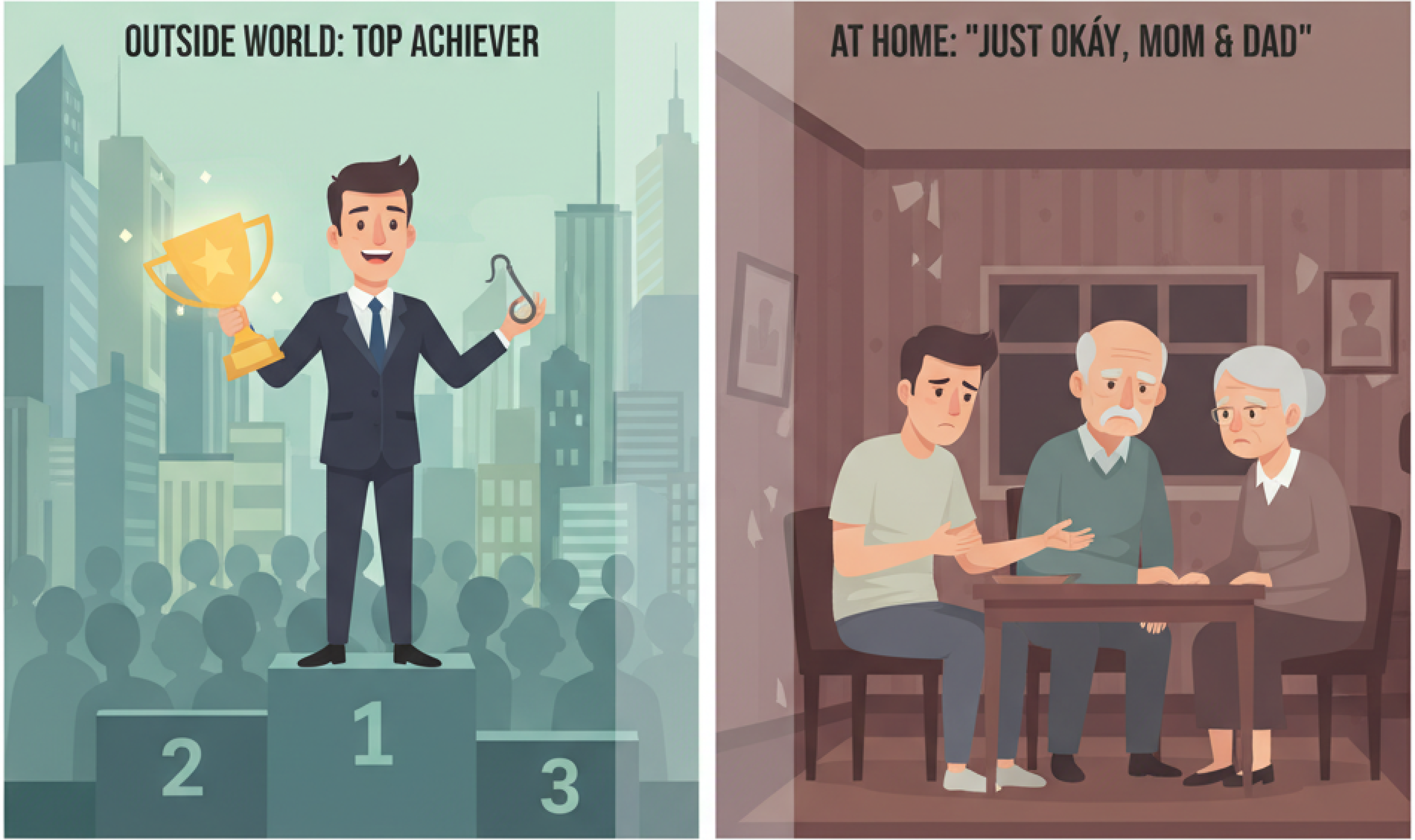
Many people prefer to portray themselves as having an average income rather than revealing their success to their loved ones. This behavior stems not from humility, but from a deep-seated insecurity rooted in a lack of past recognition. I see this reflection in myself; while I am confident in my professional capabilities and earnings among peers and colleagues, I tend to disclose only half of my actual income at home. This hesitation arises from a history of limited validation, which has gradually formed an ingrained self-doubt within the family dynamic—a lingering fear that my efforts and achievements might not be fully acknowledged by my parents.
A more profound reason for wearing this 'mask' is the fear of setting unsustainable financial expectations. Young people worry that if they were to lose their jobs, they would be unable to break the news to their families, especially if the household’s stability relies on the salary they previously disclosed. This harsh reality was illustrated in a story I read about a 21-year-old server earning 8 million VND per month, whose mother constantly demanded remittances to support a younger sibling or cover household expenses. Surprisingly, the overwhelming advice from others was for him to declare only half or a third of his actual income, allowing him to secure a financial safety net for himself.
Whether the root cause is a lack of recognition or the fear of becoming an emotional burden, it ultimately traces back to the very people who are supposed to be their 'support system.'
The insecurity and hesitation seen in young people do not exist in a vacuum; they reflect a shared responsibility that lies, in part, with the family.
So, let's ask again: why is the family like that?
The reality is that a significant number of parents place excessive pressure on their children. This pressure stems not only from comparisons to 'the child next door' but also from financial burdens and traditional generational expectations. This invisible weight creates a vicious cycle: the more capable the children become, the higher the expectations rise. These expectations then morph into psychological and financial burdens, forcing young people to hide the truth to protect their own well-being. Consequently, the family—which is meant to be a solid launchpad—becomes an anchor that holds them back in insecurity, preventing them from fully embracing their own success.
The success of a young person is not a coat to show off, but a truth earned with sweat and effort. For young people, having the courage to talk about and protect their success can be the first step to stepping out of that shadow of self-doubt. As for families, I believe that if we can transform expectations and pressure into recognition and love more subtly, the family will return to its rightful place: a safe haven and a solid launching pad for children, instead of an invisible anchor holding them back in worries and fears.
I hope that by clearly recognizing this issue, we will have a place where all young people feel comfortable being themselves, whether in society or when returning home.