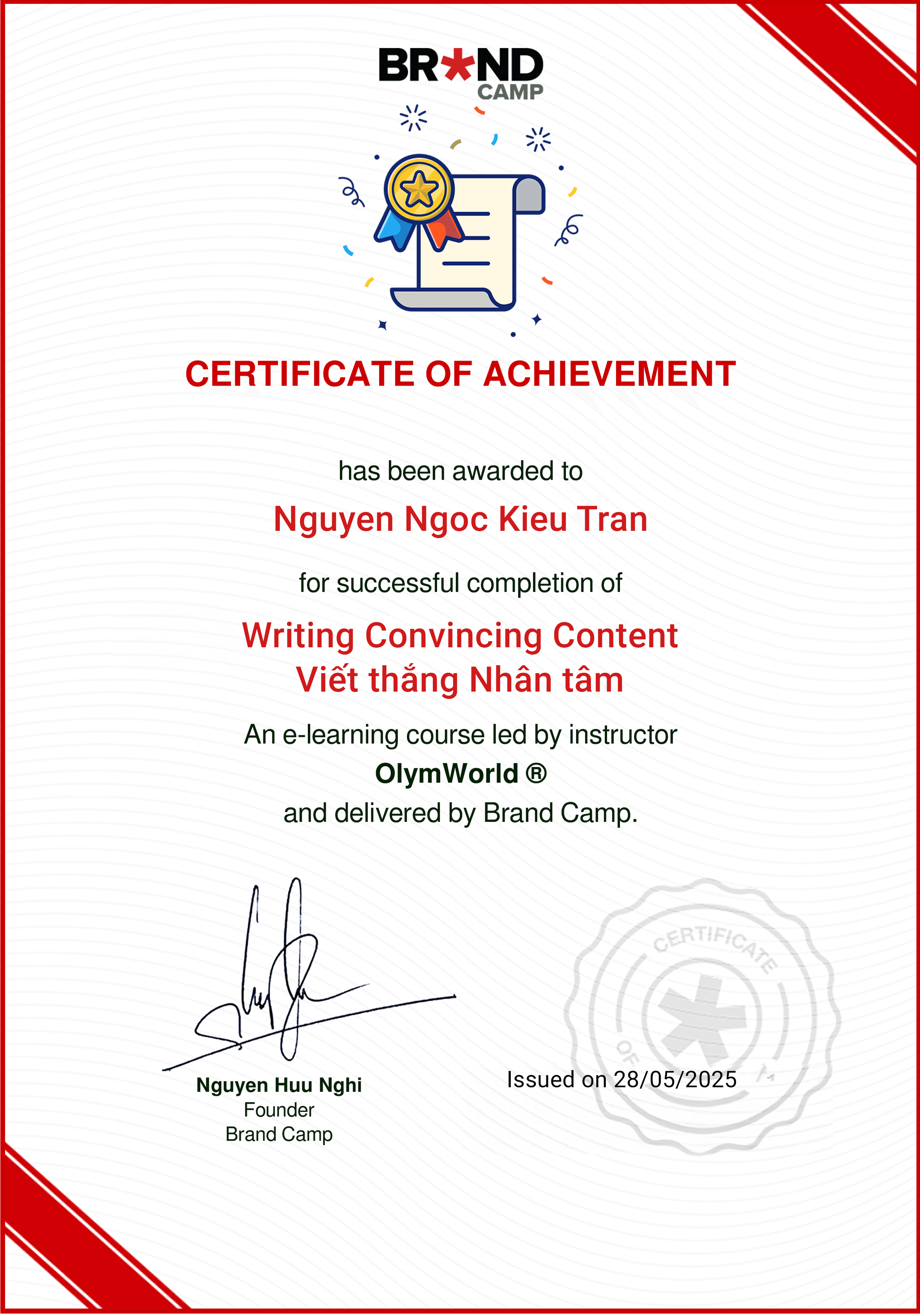
This course is not merely about learning to write; it also helps me build a systematic content creation mindset, from preparation and idea development to the method of "polishing" every word and phrase. Most importantly, it has transformed the writing process from an intuitive task into a scientific process, enabling me to create articles that achieve the set goals.
Building the Foundation: From Brief to Outline
Every effective piece of writing begins with thorough preparation.
First is to evaluate the Brief. I need to extract four core elements:
Brand, Message, Audience, and Goal. This helps me determine the appropriate Subject and Pronouns, ensuring the article's perspective and tone are consistent. For example, when writing a Guide, the subject is often "You" (second person), whereas when writing for journalism, it's best to avoid using "We" to maintain objectivity.
Next is the Outline. This outline is the framework and argumentation for the entire article, and needs to be agreed upon and approved before writing. The course provided 9 different types of Outlines, from basic ones like Description (without time elements) and Narrative (with time elements following 5W+1H), to persuasive types like Problem-Solution or Bridge.
II. Art of Language: Title, Introduction, and Development of Ideas
III. Perfection: Refinement and Self-Development
The writing process is only complete when the article achieves the highest level of polish.
After completing the first draft, I proceed with editing. The steps include reviewing the logic between ideas, simplifying redundant words, and checking for consistency in terminology.
Additionally, illustrations are also very important. I learned how to choose images that amplify the power of the words and distinguish between 4 main types of illustrations:
News, Illustrations, Quotes, Graphs/Charts.
Finally, I realized that good writing comes from practice. I need to commit to writing every day, continuously improve my expertise, and absolutely never write anything I don't believe in.